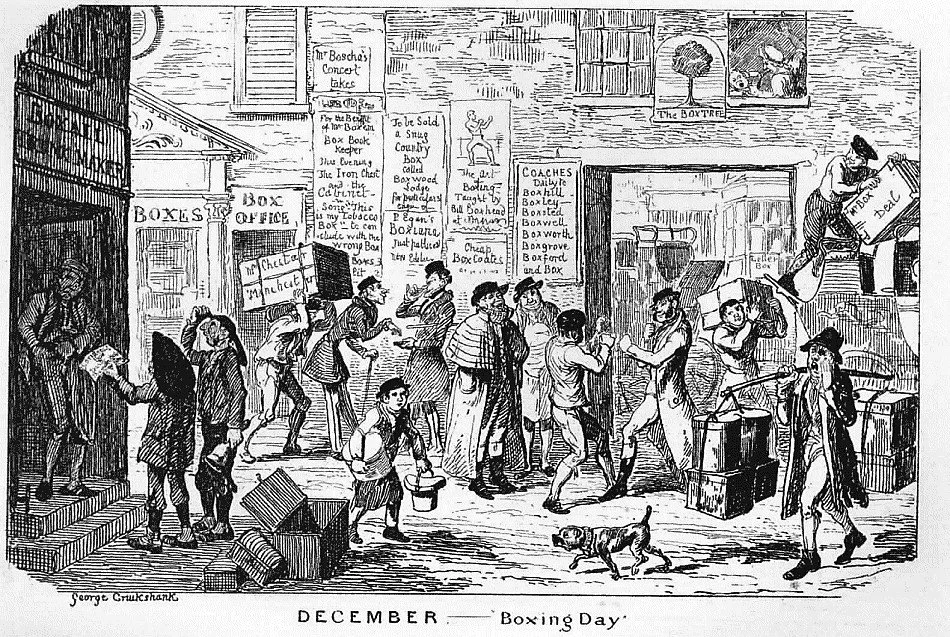
George Cruikshank, “Boxing Day,” from The Comic Almanack for 1836.
The little thank-you gift for the mail carrier, the teacher, or the neighbor who keeps an eye on the house feels like a modern courtesy. It isn’t. It’s one of the oldest holiday customs in the English-speaking world, and it has a name you already know: Boxing Day.
Long before it meant sales and leftovers, the day after Christmas belonged to the people who kept everyday life running.
Where the Box Came From
The original Christmas box was an actual box, usually a small earthenware one with a slot, like a piggy bank. In the 1600s, apprentices carried them around to their masters’ customers at Christmas, collecting coins. When the box was full, it was broken open and the money shared. A 1611 French-English dictionary already lists “a Christmas box” as a translation of tirelire, the French word for a money box.
Churches kept boxes of their own. Alms collected over the season were opened after Christmas and given to the poor.
Over time, the box became a figure of speech. A “Christmas box” came to mean any small seasonal gift or tip, and “to box” someone meant to give them one. Samuel Pepys grumbled in his diary on December 28, 1668, that “boxes” had “cost me much money this Christmas already, and will do more.” Some things never change.
Who Got a Christmas Box
By the 1800s, the day after Christmas had its own name. A Sheffield newspaper in 1822 described it as “the great, the eventful day to the poorer classes, called Boxing Day.”
The recipients were the people a household relied on all year: the letter carrier and the lamplighter, the butcher’s boy and the baker’s boy, the dustman who hauled away the ashes. Household servants, who had worked through Christmas Day so their employers could celebrate, were given the next day off and a box to take home to their own families.
The custom was popular enough that when Britain created its first official bank holidays in 1871, Boxing Day was one of them. It’s still a holiday in the UK, Canada, Australia, and much of the Commonwealth.
The Christmas Box Today
We don’t have lamplighters anymore, but the list is still familiar. The mail carrier is still on it. The baker’s boy has become the barista who knows your order. The household staff are the pet sitter, the cleaner, and the person who shovels the walk. And the list has grown to include people the Victorians never imagined: the teacher, the coach, the coworker who covers for you, the neighbor who takes in your packages.
The spirit hasn’t changed either. A Christmas box was never meant to be lavish. It was a modest, practical token, given to many people at once, that said: I noticed what you do, and I’m grateful. That’s still the right size for a thank-you.
A Box of Your Own
If you’d like to keep the tradition, it doesn’t take much. Make a list of the people who make your year easier, and settle on one small gift you can give to all of them. Mine is a cocoa-and-cookie bag for under $5, and the free holiday planner has a page for exactly this list.
Make them now, before the rush, and keep them by the door. When the mail carrier comes up the walk in December, you’ll be ready with a Christmas box of your own.